
The Wrong Bus
The bus reached our stop. One of us did not.

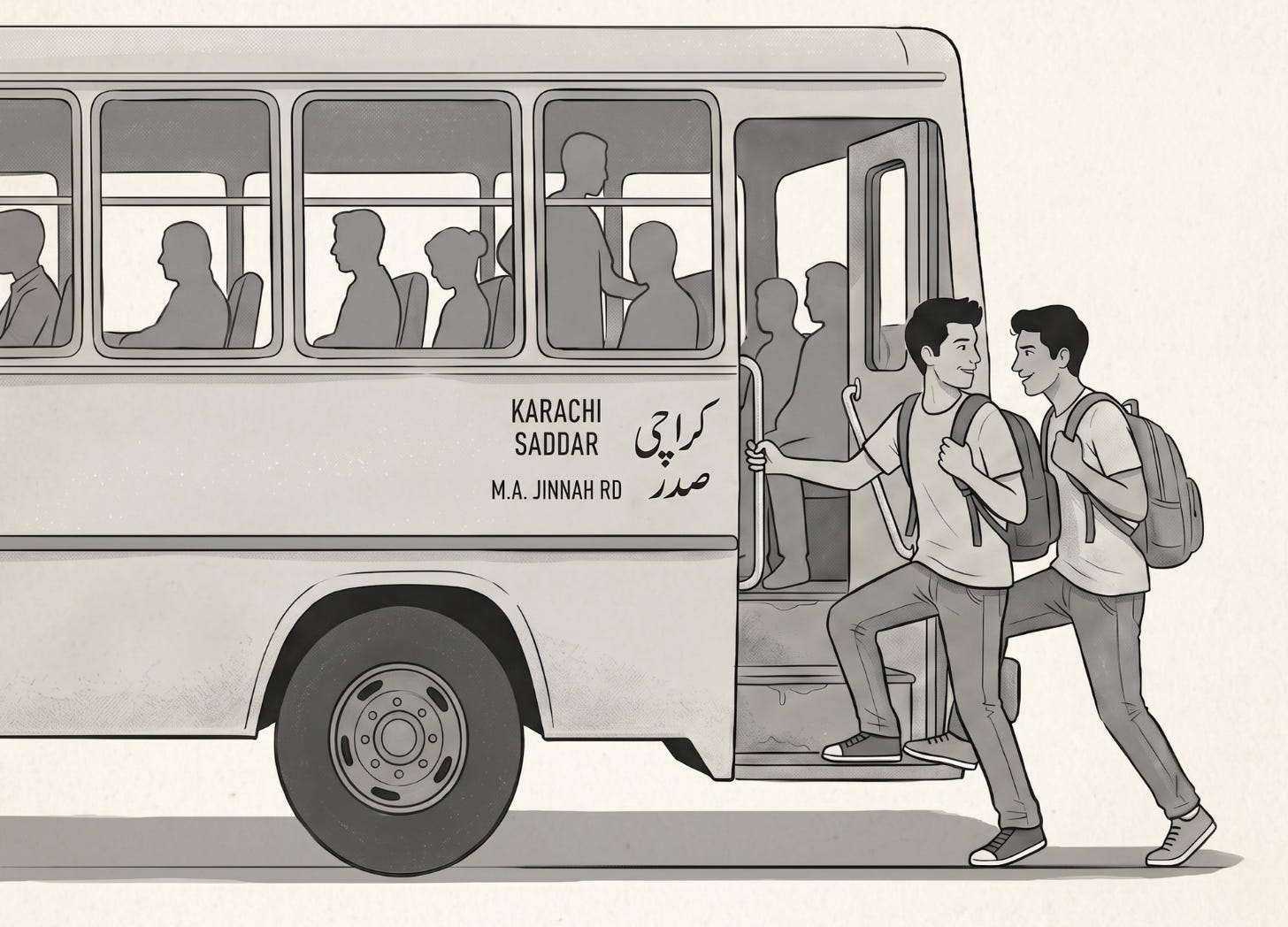
Most of the afternoons I should have spent becoming an educated man, I spent learning how not to pay bus fare.
This was Karachi in 1997. I was an undergrad student, and still believed one unfair thing deserved another. Hameed lived near me and had acquired, over time, the dangerous habit of following me into trouble. He claimed he did it for fun. I suspected he came along to make sure I returned with my wallet, my shoes, and most of my teeth.
We were classmates. That meant we arrived together in the morning and suffered together in the evening. At five, the university shuttle dropped us at our stop and went growling away, leaving us in the yellow Karachi heat with our bags on our shoulders, our shirts stuck to our backs, and forty minutes of walking between us and home.
There was, however, a cure.
A city bus.
Any city bus, almost. It cut the walk in half and gave us enough time for the arcade, where Hameed and I took Street Fighter very personally. There was only one problem.
The fare.
Two stops or twenty, the conductor wanted the same money. To us, this was daylight robbery.
There was another weakness in the system: there was no receipt. Once you paid, the conductor had to remember you, and on a full bus, memory had limits.
So I invented what I called the wrong bus ritual.
The rules were simple. We boarded only full buses. If the conductor was near the front, we climbed in from the back. If he was near the back, we climbed in from the front. We stayed near the door when we could, fingers hooked around the frame, ready to become pedestrians. Then we watched the conductor make his slow advance through the crowd, shoulder by shoulder, collecting coins, refusing excuses, and arguing with aunties who believed three children in one seat still counted as one passenger.
Most days, our stop arrived before he did.
On the days he did reach us, I had my answer ready.
“Two tickets for Clifton.”
He would stare at me.
“Clifton? This bus doesn’t go to Clifton.”
I would look wounded, then alarmed.
“Stop the bus. We have to get off.”
The conductor would wave me down.
“Not here. Next stop.”
Which was our stop.
Then Hameed would turn to me with massive disappointment.
“How many times,” he would say carefully, “do I have to tell you to read the bus number?”
Then we would get off with the dignity of two boys who had been betrayed by public transportation.
This went on for two years. I had almost forgotten it until last month, when I told the story to Suleman.
He laughed where he was supposed to laugh.
Then he kept laughing.
“I remember this like it happened yesterday,” he said.
“This was in our fourth semester. I was going to Hameed’s house for a project, and the three of us got off the shuttle and took the bus together. And you know what?” He leaned forward. “The bus wasn’t even full.”
This is the trouble with old friends. They can ruin a good story with facts.
“You were standing,” he said. “I was sitting with Hameed. When the conductor started coming toward us, I reached into my pocket. Hameed slapped my hand.
“‘Don’t be crazy,’ he said. ‘You’re a guest. This is on us.’”
As Suleman said this, I remembered the moment. Hameed had said it proudly, then cut his eyes toward me as if I had almost missed my cue.
Suleman continued.
“The conductor came up behind you, but you were facing us. You knew he was there. You just didn’t turn around. He asked once. Then again. Finally Hameed said, ‘Look behind you.’”
“You turned like someone had interrupted an important meeting,” Suleman said.
“You said, ‘What happened, brother?’
“The conductor said, ‘Ticket.’
“You looked at me. Then at Hameed. Then back at the conductor, completely offended.
“‘O brother,’ you said, ‘how many times do you want to charge us?’
“The conductor apologized. He actually apologized. Then he turned around and walked away.”
According to Suleman, I was so convincing that even he wondered if I had somehow paid without noticing.
“There was another student who got off the shuttle with us,” Suleman continued. “He was watching you too. When you and Hameed gave each other a high five, he leaned toward me and said, ‘Can you believe these bastards? They’re robbing a poor man.’”
That was Wasif.
Wasif was a freshman who had started appearing at our stop around then. He lived near us and rode the same buses. We liked him, more or less. We even invited him into our system, but he made the whole business unpleasant.
He would stand near the conductor, take out the money before being asked, pay the fare, and then glance back at us as if the transaction came with a certificate of character.
Some days, after getting off the bus, Hameed would go quiet on the walk home. I would toss pebbles at his shoes until he turned and raised one finger.
“Don’t.”
Wasif had not just paid the fare. He had made it personal.
Then one day, Wasif rode with us.
The bus was almost full, but not full enough. Nobody was standing.
We sat together in the last row: Hameed on my left, next to the exit, Wasif on my right.
The conductor saw us and began his slow walk down the aisle, one hand sliding along the overhead rail.
Wasif leaned in.
“Look, guys,” he said. “I don’t have cash at the moment. I would appreciate it if you could include me in your scheme today.”
For one second, I thought he had finally come around.
I turned to Hameed.
He looked straight ahead and gave the smallest shake of his head.
The conductor reached us.
“Ticket?”
I was still arranging my face into innocence when Hameed put a hand on my shoulder. Then he reached into his shirt pocket and gave the conductor exact change.
“This is for me and him,” he said, pointing at me.
I stared at him.
Then Hameed leaned across me and grabbed Wasif’s wrist.
“This guy has the money,” he said, “but he is going to tell you he rode the wrong bus.”
Wasif looked at Hameed.
The conductor looked at Wasif.
I looked at the floor. The rubber matting had become very interesting.
Hameed leaned back and looked out the window.
At our stop, Hameed and I got off.
The bus pulled away in a cough of smoke and heat.
We turned back. Wasif was not with us.
On the walk home, we gave the matter the serious reflection it deserved. Which is to say, we laughed until the stop disappeared behind us.
The next morning, Wasif was waiting at the shuttle stop.
“You assholes,” he said. “I reached home at seven p.m.”
Follow me on LinkedIn for daily insights shared with 90,000+ incredible minds.
If you’re looking to grow your career, here are five ways I can help you:
The Resume Ghostbuster: Join 5,000+ people who’ve transformed their resumes into recruiter magnets. Use the robust AI script to transform your resume into the template of your choice. Includes LinkedIn profile update and job search strategies.
The Top Engineer Method: Join 1,000+ engineers worldwide and master the skills AI can’t touch. Learn to showcase your work, build influence, and navigate politics to keep your career in your control.
The Top Tech Leader Method: Join 500+ engineering leaders across the globe inside The Top Tech Leader Method. Learn the People Intelligence skills I used to lead high-performing teams, influence executives, and grow into an engineering executive at startups and top-tier tech companies.
Personalized 1:1 Coaching: Work with me directly to debug your inner system, reset your operating state, and break the cycle of high-functioning burnout. This is where we do the deep work.
Visit Taha’s Method: For more courses, tools, and practical guides.